
 By
By 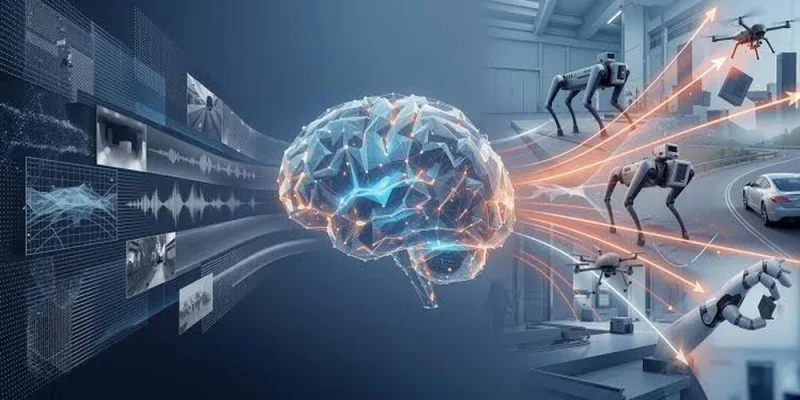
Industrial robots have traditionally been excellent specialists. Give them a stable fixture, predictable component position and carefully programmed sequence, and they can repeat the same task thousands of times with speed and precision. Manufacturing, however, is moving in the opposite direction: more product variants, shorter runs and more frequent changes are increasing the amount of uncertainty automation must handle.
That mismatch is creating space for Physical AI. Rather than replacing conventional robotics with an entirely different technology, Physical AI adds perception and decision-making capabilities that allow automated equipment to respond to conditions it has not been explicitly programmed to handle in exactly the same way every time. The result is a gradual shift from automation based primarily on repetition toward automation capable of interpreting its environment.
Pre-programming works best when reality stays predictable
Traditional robot programming assumes that engineers can describe the task in advance. A robot may move to predefined coordinates, close a gripper, transfer a component and place it into a machine according to a fixed sequence. Sensors can provide basic confirmation, but the underlying process usually depends on physical consistency.
Manufacturers achieve that consistency with fixtures, feeders, pallets, guards and tightly controlled material presentation. This engineering is entirely rational because removing uncertainty makes automation reliable. It also creates cost, however, particularly when every new component or production variant requires changes to tooling, programs or cell configuration.
High-mix operations expose the weakness particularly clearly. When a factory produces many different parts in relatively small quantities, the engineering effort surrounding each automation change can consume a meaningful share of the expected productivity gain. Trener Robotics describes frequent changeovers, variable part presentation and dependence on specialist programming as some of the areas where traditional approaches become difficult to scale.
A robot begins with perception, not movement
Physical AI changes the sequence of thinking about an automated task. Instead of starting only with a predefined robot trajectory, engineers can increasingly begin with the environment: what does the machine need to recognize, what variations should it tolerate and what information is required before it chooses an action? Cameras, force sensing and other inputs become part of the control process rather than simple peripheral devices.
Consider machine tending. A conventional cell might require components to arrive in precisely defined positions, whereas a perception-enabled system can potentially identify their location and orientation before deciding how they should be picked. If the component has shifted, the response can change accordingly instead of immediately producing a fault or requiring someone to restore the original arrangement.
This perceive-decide-act-verify cycle is central to discussions of Physical AI in manufacturing, because physical intelligence depends on feedback after the movement as much as recognition before it. Confirming that a component was grasped correctly, that it remained secure during transfer and that the intended operation was completed allows subsequent decisions to use information from the real process rather than assumptions encoded during programming.
Manufacturing becomes a training environment
Greater adaptability does not appear automatically when a camera is connected to a robot. AI-driven systems need representative data, defined objectives and extensive testing across normal operation as well as edge cases. Manufacturers therefore face a different engineering problem from traditional robot commissioning: they must consider what the system has experienced, what it has not experienced and how it behaves when confidence is low.
Simulation helps make that process practical. Developers can construct digital environments, expose robotic policies to many variations and generate synthetic data before moving to the real cell. NVIDIA’s current robotics strategy explicitly combines foundation models, physically based simulation and embedded inference, reflecting a broader industry effort to shorten the path between virtual training and deployment on real machines.
The factory still provides the final reality check. Materials deform, lenses become dirty, lighting changes and components accumulate tolerances that virtual models may not capture perfectly. Successful deployment therefore requires systematic validation and monitoring rather than an assumption that an AI model trained in simulation will behave flawlessly after installation.
The first opportunities are likely to be ordinary ones
Discussion about Physical AI frequently gravitates toward humanoid robots, but manufacturing does not need to wait for general-purpose machines to benefit from the underlying technology. Many near-term applications involve familiar industrial equipment gaining greater ability to perceive variation and adjust its actions. Machine tending, flexible material handling, inspection and logistics are natural candidates because environmental uncertainty already limits how far conventional automation can economically reach.
The strongest business case is likely to appear where manual work exists not because the physical movement itself is unusually difficult, but because variability makes conventional automation cumbersome. Loading multiple component types into machinery is a good example. If every SKU requires dedicated presentation equipment and lengthy programming, automation may struggle to compete with a trained operator despite attractive robot cycle times.
Physical AI can reduce some of that rigidity, but it does not eliminate engineering economics. Companies still need to evaluate throughput, integration, safety, maintenance, training and the consequences of downtime. A technically impressive system that requires scarce specialists whenever conditions change may simply replace one form of dependence with another.
Success will be measured by recovery, not demonstrations
Traditional automation is often evaluated around nominal performance: cycle time, repeatability, availability and output. Those metrics remain important, but adaptive systems introduce another useful question – what happens when reality stops matching the ideal process? A system’s ability to recognize an exception, recover safely and continue production may matter as much as its performance during perfect cycles.
That changes how manufacturers should approach pilots. Rather than demonstrating only a carefully selected task under controlled conditions, teams should deliberately test variation: different part positions, minor presentation errors, interruptions and borderline cases. The objective is not to prove that the AI never encounters uncertainty, but to understand how predictably it behaves when uncertainty appears.
Physical AI is therefore entering manufacturing less as a dramatic break with industrial automation than as an additional layer of capability. Robots will still need reliable mechanics, appropriate tooling, safety systems and well-designed processes. What changes is their potential to interpret more of the environment for themselves, allowing automation to extend into operations where rigid pre-programming has historically been the limiting factor.




Comments